
Backed by a court order, India is expected seek extradition of Lashkar-e-Tayyiba operative David Coleman Headley and his accomplice Tawwahur Rana. But this is going to be an uphill task for investigators, reports Vicky Nanjappa.
Gujarat Chief Minister Narendra Modi on Friday said that the clean chit given to Tahawwur Rana in Mumbai terror attack-related charges by a United States court was a "foreign policy setback", and demanded that India reconsider its policy towards the United States. "Just to please Pakistan, US has unlocked the ways for all the 26/11 Mumbai attack terrorists to be free of guilt. It is time the central government rethink its policy towards US," Modi said.
Two days after reports of Tahawwur Rana admitting to providing support to 26/11 terrorists at the behest of Pakistani government and the Inter-Services Intelligence, his attorneys on Thursday denied any "knowing involvement" of the Pakistani-Canadian in the attacks.

Pakistani-origin terror convict Tahawwur Rana, whose extradition to India has received a green signal, was 'very relaxed' in the days after the 26/11 attacks and wanted Pakistan's highest military honour to be bestowed on the Lashkar-e-Taiba (LeT) terrorists who carried out the carnage in Mumbai.
A United States court has denied the writ of habeas corpus filed by Pakistani-origin Canadian businessman Tahawwur Rana, paving the way for US Secretary of State Antony Blinken to issue a certification for him to be extradited to India where he is sought for his involvement in the 2008 Mumbai terror attacks.

Tahawwur Hussain Rana, a Pakistan-born Canadian national and close associate of David Coleman Headley, could be extradited to India in connection with the 26/11 Mumbai terror attacks. Rana's travel history in parts of north and south India before the attacks in 2008 is expected to provide crucial leads for the investigation. His extradition would mark the third person to be tried in India for the attacks, after Ajmal Kasab and Zabiuddin Ansari alias Abu Jundal.
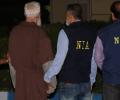
The National Investigation Agency (NIA) has begun questioning Tahawwur Hussain Rana, the mastermind behind the 2008 Mumbai terror attacks, to uncover the larger conspiracy behind the deadly strikes. Rana, who was extradited from the US, is being held at the NIA headquarters in New Delhi. The interrogation is focused on his possible connection with the Lashkar-e-Taiba (LeT) and his suspected links with the Pakistani spy agency Inter-Services Intelligence (ISI).
The trial of Pakistani-Canadian Lashkar-e-Tayiba operative Tahawwur Rana, co-accused with David Headley in the 26/11 case, is set to begin in Chicago on May 16. If insiders are to be believed, Rana is likely to implicate Pakistan's Inter-Services Intelligence in the Mumbai terror attacks, reports Vicky Nanjappa.
Tahawwur Hussain Rana, a Canadian national accused of involvement in the 2008 Mumbai terror attacks, has been extradited to India from the United States. Rana's interrogation is expected to shed light on the role of Pakistani state actors in the attacks, which claimed 166 lives. Indian authorities are particularly interested in his travels across India in the days leading up to the attacks, including visits to Hapur, Agra, Delhi, Kochi, Ahmedabad, and Mumbai. Rana's extradition follows a lengthy legal battle, with the US Supreme Court ultimately denying his application to challenge it. Rana is known to be associated with Pakistani-American terrorist David Coleman Headley, one of the main conspirators of the 26/11 attacks. The investigation into the Mumbai attacks has implicated senior members of terror outfits Lashkar-e-Taiba (LeT) and Harkat-ul Jihadi Islami (HuJI), as well as officials from Pakistan's Inter-Services Intelligence (ISI).

The United States has extradited Pakistani-Canadian Tahawwur Hussain Rana to India to face charges for his alleged involvement in the 2008 Mumbai terrorist attacks. Rana, 64, was convicted in the US in 2011 for providing material support to Lashkar-e-Taiba, the Pakistani militant group responsible for the Mumbai attacks. The US Department of State said it has long supported India's efforts to bring those responsible for the attacks to justice and that the extradition is a critical step towards seeking justice for the victims. Rana's extradition comes after the US Supreme Court denied his last-ditch attempt to evade extradition. He will now face justice in India for his role in the attacks which killed 166 people, including six Americans.
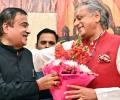
Senior Congress leader Shashi Tharoor welcomed the extradition of Tahawwur Hussain Rana, a key accused in the 26/11 case, and said everyone associated with the conspiracy of the Mumbai terror attacks must face the court of justice. He described Rana's extradition as a "step forward for justice." Rana, a Pakistan-born Canadian national and close associate of David Coleman Headley, is being brought to India after his last-ditch attempt to evade extradition failed. Tharoor expressed hope that the interrogation of Rana would provide more details about the Mumbai attacks and said he was "very glad" that Indian authorities managed to get Rana's custody.

Tahawwur Hussain Rana, a Canadian national convicted in the United States for his role in the 2008 Mumbai terror attacks, has been extradited to India. Rana, a close associate of Pakistani-American terrorist David Coleman Headley, was involved in the conspiracy from 2005 onwards and assisted Headley in obtaining a visa for India. He is the third person to be sent on trial in India for the 26/11 attacks after Ajmal Kasab and Zabiuddin Ansari alias Abu Jundal. Rana's extradition comes after US President Donald Trump approved the request.

Pakistan's record on terrorism is "very clear" and the Pahalgam attack is only the recent example of cross-border terrorism, the ministry of external affairs said on Thursday.

In more than a decade since 2002, 60 fugitives were extradited or deported by foreign governments to India, which received a major victory in its fight to bring the perpetrators of the 26/11 Mumbai attacks to justice when a US federal court agreed to the extradition of Pakistani-origin Canadian businessman Tahawwur Rana to the country.
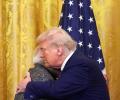
The talks between Prime Minister Narendra Modi and Donald Trump in Washington were marked by the US president's generous praise of the Indian leader and his consideration of India's stance on several issues, officials said on Friday.
The Indian Consulate in Chicago said the papers related to issuance of visas to terror suspects David Coleman Headley and Tahawwur Rana had not gone missing and the 'relevant information' in this regard is available with the Indian government.
The verdict of a Chicago court jury to acquit Pakistani-Canadian Tahawwur Rana of charges of involvement in the Mumbai terror attacks is disappointing, a top United States government attorney said on Friday.
United States prosecutors have taken strong objection to Pakistani-American Mumbai terror attack suspect Tahawwur Rana's assertion that he believed in the principles of non-violence advocated by Mahatma Gandhi, claiming that he 'admired and supported mass murderers'. While seeking a bond, defendant Rana had argued that he believes in non-violence.
The Canada-based brother of terror suspect Tahawwur Rana has come out in support of his brother saying the charges against him are false and described Rana as a "man of integrity".
David Headley, who was involved in the Mumbai terror attack, was a liar and ditched his school time pal Tahawwur Rana, the Pakistani-Canadian's attorney told a Chicago court on Tuesday, claiming that their friendship was over and they would never meet again.
There has been a huge cover-up of the LeT iceberg in India that helped David Headley and Tahawwur Rana plan the 26/11 terror strike, says B Raman
Tahawwur Rana facilitated David Coleman's foreign visits and was aware of his links to the Lashkar-e-Tayiba, writes strategic expert B Raman.
Mumbai attacks accused David Headley had repeatedly told his Federal Bureau of Investigation interrogators that his friend and co-accused Tahawwur Rana was unaware of his terror activities and had not provided any support to him knowingly, details that were omitted from an affidavit filed before a court, recently unsealed documents reveal.
Ahead of his February 24 hearing, Lashkar-e-Tayiba terror suspect Tahawwur Rana has sought a date from a court in Chicago for a pretrial conference to ensure a fair and expeditious trial for him, according to his lawyer.
Tahawwur Rana, who was found guilty of providing support to Pakistan-based terror group Lashkar-e-Tayiba, had cited omission of crucial exculpatory evidence in his case to seek a fresh hearing, recently unsealed court documents have revealed.
The defence for Tahawwur Rana, co-accused with David Headley in the 26/11 attacks, rested its case in Chicago after calling two witnesses but the Pakistani Canadian himself did not testify.
Terror suspect Tahawwur Rana's lawyer said on Wednesday that he had never suggested that "Rana is Gandhi", a day after US prosecutors here claimed that the Pakistani-Canadian's beliefs were "akin" to those of non-violence advocated by Mahatma Gandhi.
Terror suspects David Coleman Headley and Tahawwur Rana, indicted on charges of being involved in the Mumbai terror attacks, will be arraigned in a court in Chicago next week. The arraignments of Rana and Headley were initially scheduled for Wednesday, but have now been rescheduled. While Pakistani-Canadian citizen Rana will be arraigned on January 25, Pakistani-American Headley's arraignment has been set for January 27.
Facing criticism for issuing multi-entry visas to suspected terrorists Tahawwur Rana and his wife, the Indian Consulate in Chicago said on Wednesday that the visas were given after "due scrutiny of the available documents".
The verdict of a Chicago court jury to acquit Pakistani-Canadian Tahawwur Rana of charges of involvement in the Mumbai terror attacks is disappointing, a top United States government attorney said on Friday.
Rediff.com has in its possession FBI footage of Rana's interrogation where he has spilled the beans about ISI's dealings with the Lashkar-e-Tayiba and the role played by David Coleman Headley and Pakistan Army officers in 26/11.
Family members and friends of Tahawwur Rana, who was arrested by the Federal Bureau of Investigation on charges of plotting terror attacks in India at the behest of the Lashkar-e-Tayiba, on Thursday vouched for his 'honesty' and 'non-violent nature' in a court hearing in Chicago.Rana's bond hearing, held before United States Magistrate Judge Nan Nolan, was attended by his family, including his parents-in-law, friends and acquaintances.Judge Nolan postponed the decision.
Tahawwur Rana, the 26/11 co-accused, did not congratulate co-conspirator David Coleman Headley, unlike several others, on the success of the Mumbai terror attacks, attorney of the Pakistani-Canadian said during the trial.
A US court again turned down the bail plea of terror suspect Tahawwur Rana, accused of plotting terror attacks in India at the behest of the Lashkar-e-Tayiba, on Thursday saying the Pakistani-Canadian is charged with "very serious crimes" which give him a motive to flee.
The curious case of the Indian Consulate in Chicago issuing a visa to Pakistani-Canadian Tahawwur Rana, who was arrested by the Federal Bureau of Investigation for allegedly plotting terror attacks in India, appears to be getting more complicated. Both Rana and his wife Samraz Rana had been issued multi-entry visas by the Consulate with the visa stamp clearly stating that this had been issued at the 'discretion of the CG' (Consul General).

India has sought access from the United States to the 26/11 Mumbai terror attack convict David Headley and his accomplice Tahawwur Rana -- both of whom were sentenced by a Chicago court after being found guilty of terrorism charges.
The Indo-US extradition treaty may pose a major hindrance to India's efforts to produce David Headley and Tahawwur Rana before a Delhi court over the Mumbai attacks, as it does not allow handover of a person already convicted or acquitted for the offence he has been sought for.
The Indian government has cancelled visas of Pakistani-origin terror suspects and Lashkar-e-Tayiba operative David Coleman Headley and Tahawwur Rana, according to sources.
The "serious" prison sentence for Pakistani-Canadian Tahawwur Rana should send a tough message to all individuals planning to indulge in any direct or indirect terrorist activities that they cannot escape detection and punishment, US prosecutors said on Friday.
A video of the Federal Bureau of Investigation interrogation of Tahawwur Rana, a key suspect in the Mumbai attacks, has been screened for the first time by the prosecution in his trial at a court in Chicago, in which he is shown talking about Pakistan's Inter-Services Intelligence giving weapons to co-accused David Headley.
 © 2026 Rediff.com - Advertise with us - Disclaimer - Privacy Policy - Sitemap - Feedback - About us - Terms of use - Grievances